First things first, I have been away for a few days in Saskatoon visiting my brother with my family. It was great to have a rest. My daughter saw her very first Axolotl (an animal with which she was already obsessed), and again, people keep telling me that I’m happier. That’s all I’m going to write about the vacation for now. Nice trip.

Onward to some business.
I’ve been getting some postings and positions sent to me (thank you!) and there appear to be a large number of opportunities out there. Right now I’m looking for a great fit, so I’m being picky. It is nice to have this luxury, and time with my family too.
After spending the last few weeks going through job postings in the data / analytics / AI space, I’ve come to the conclusion that job titles in our industry have almost completely lost their meaning.
I’ve seen “Data Analyst” roles that are Excel dashboards.
I’ve seen “Data Analyst” roles that require machine learning, Python, cloud engineering, and production deployment.
I’ve seen “AI Engineer” positions that are really data engineering.
I’ve seen “Data Scientist” roles that are just SQL reporting.
And I’ve seen “Analytics” used to describe everything from counting rows to building predictive systems.
None of this is malicious. Most organizations are still figuring out what a modern data team is supposed to look like.
The problem is that we’ve ended up with a pile of titles that overlap so much they don’t tell you anything anymore.
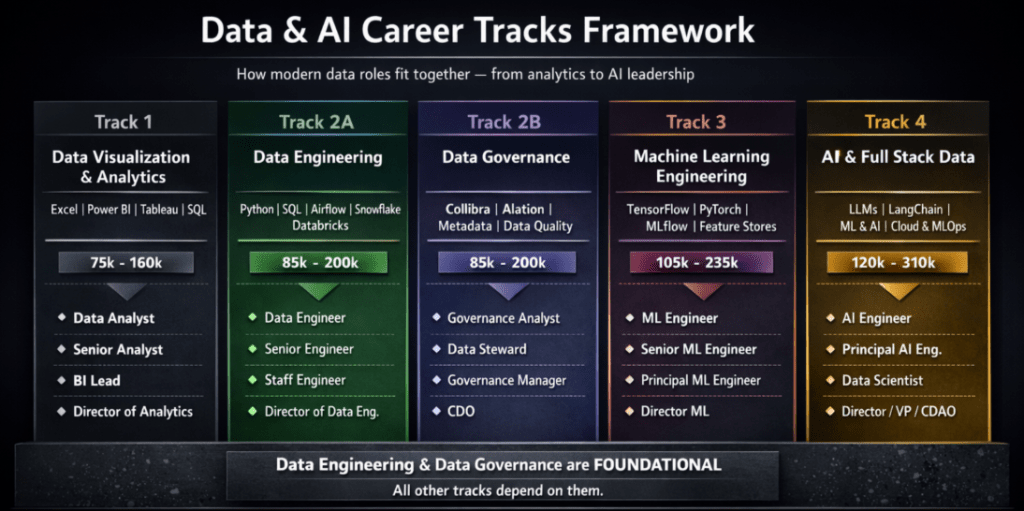
So I put together a simple framework to describe the way I tend to think about the space. Not as a hierarchy, but as different tracks that sit on top of the same foundation.
The biggest thing I wanted to highlight is this:
Data Engineering and Data Governance are not optional.
They are the foundation.
Without reliable pipelines, clean data, proper metadata, and sane access control, everything else is built on sand. Dashboards lie. Models drift. AI hallucinates. And everyone ends up arguing about whose numbers are right.
Ironically, these are also the areas that often get underfunded first, because when they work properly, nobody notices them.
Another thing that gets lost in job descriptions is the difference between specialization and ownership.
There is a huge difference between:
someone who works in one layer of the stack
and
someone who can take a data product from ingestion to modeling to deployment to governance.
Both are valuable.
But they are not the same role, and they shouldn’t be priced the same.
The salary ranges in the graphic are rough, based on what I’ve seen across multiple industries. They vary a lot depending on company size and how mature the data organization is. A large enterprise with a real platform looks very different from a company that just decided last year that it needs “AI”.
This isn’t meant to be the final word.
Just one attempt to put some structure around a space that has gotten very blurry.
Curious where people disagree.
What titles have you seen that made no sense at all?
Takes existing data — from databases or spreadsheets — and visualizes it in dashboards or mines it for insights about the current state of the business. It can identify trends, but only those visible on a superficial view of the data.
Tracks 2A and 2B are foundational. Without solid data engineering there is no reliable data to analyze, model, or govern. Without governance you cannot trust the data you are engineering or modeling. Every other track on this list sits on top of these two — yet the industry chronically undervalues them because the output is invisible when it is working.
The practice of moving, cleaning, and preparing data for consumption. Data engineers build pipelines, ETLs, and API connections, storing data in managed centralized locations along with the necessary information about lineage and structure.
Ensures that data quality is maintained, that complete and sufficient metadata exists, and that permissions and access are correct, secure, and accurate. The goal is that users can find the data they need, that they have access to, with a minimum of friction.
Applies machine learning algorithms to existing data to predict and prescribe future events. This adds meaningful value beyond descriptive analytics and requires a sophisticated understanding of relatively complex algorithms to ensure they are being selected and applied correctly.
Deploys advanced AI through connections to large language models, retrieval augmented generation (RAG), and agentic frameworks to augment decision making around data. AI engineering can evaluate multiple data sources and combine them into a single, coherent, explainable output.
Encompasses a breadth of all other disciplines — data engineering, statistical modeling, machine learning, AI, governance, and visualization. Full stack practitioners design and deploy end-to-end data products, leveraging other specializations and bringing together the complete final solution.
Salary bands are approximate CAD ranges. Vary by industry, company size, and region.
Edit: I probably should make it clear, I’m a full-stack. I’ve built pipelines and dashboards, ML models and applications, set up cloud platforms (Databricks) and maintained both the governance and standards. This is what I’m looking for. Something in full stack leadership so I can help others with this.
https://brettwiens.com/professional/: Day 15-20 – Vacation and Job Titles Brett Wiens